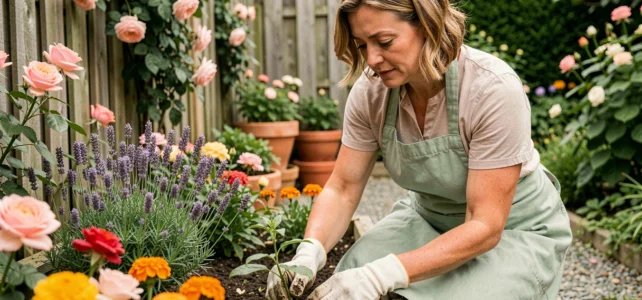
A coherent flowering garden relies less on the number of varieties planted than on the logic of the composition of plant layers and the consideration of the actual soil. We regularly observe beds overloaded with annuals, without a permanent framework, which lose all readability by the second season. Structuring a harmonious garden requires thinking in terms of volumes, flowering rhythms, and edaphic constraints before choosing any plant.
Soil and exposure: the two parameters that dictate plant choice
No plant palette works if it ignores the pH and texture of the soil. A clayey soil that is waterlogged in winter points towards perennials for cool ground (astilbes, ligularias, persicarias), while a draining and calcareous soil calls for Mediterranean plants or dry prairie grasses. Testing the soil before planting is crucial for success over several years.
Exposure is not limited to the dichotomy of shade/sun. The duration of direct sunlight, the shade cast by a building in the afternoon, and the reflection from a light-colored wall radically change the behavior of plants. An area receiving morning sun but protected from 2 PM onwards is suitable for perennial geraniums, heucheras, or foxgloves, but not for lavenders, which will stretch out.
We recommend mapping the areas of shade and light at four different time slots before designing any bed. This survey, conducted in June when the tree foliage is complete, provides a reliable reading. Among the useful resources for deepening the design of suitable beds, the garden on the site Le Blog de Coco offers complementary approaches.
Plant layers and structure of the flowering bed
A harmonious bed functions in three overlapping layers: the canopy (flowering shrubs or small trees), the intermediate layer (tall perennials, grasses), and the ground cover. Without this height structure, a bed appears flat regardless of the number of colors.
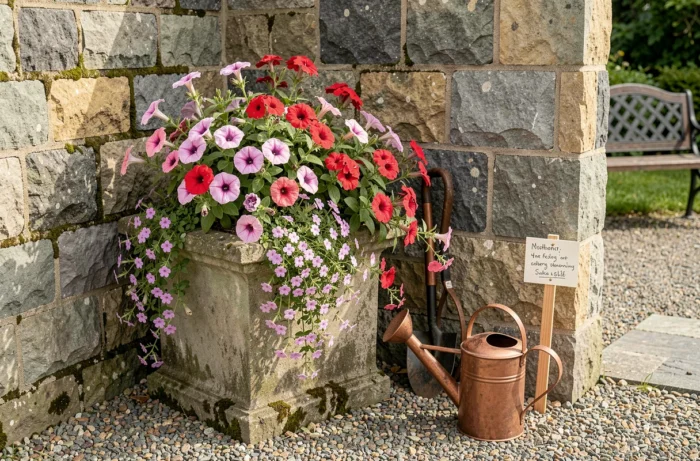
Shrub framework: the permanent skeleton
The upper layer structures the bed even in winter. A Cornus kousa, a Hydrangea paniculata, or a Viburnum plicatum provide volume, summer flowering, and winter silhouette. Planting at least one architectural shrub for every five linear meters of bed gives a focal point that is readable from the house.
Evergreen shrubs (osmanthus, pittosporum, sarcococca) ensure visual continuity from December to March, a time when perennials have disappeared. A flowering garden that only works six months out of twelve reveals a deficit of woody structure.
Perennials and grasses: the heart of flowering
The intermediate layer carries the majority of the colors. The classic trap is to multiply different species in single specimens, resulting in a “collection” effect without coherence. We recommend planting in groups of three to seven identical subjects, in irregular drifts, to create readable color masses.
Grasses (miscanthus, stipa, molinia) play a binding role between successive blooms. Their transparency allows for seeing through, which adds depth to the bed. Grasses are the binding element that unifies a heterogeneous bed.
- Stipa tenuissima for drained soils and the front of the bed, with a permanent movement effect in the wind
- Miscanthus sinensis ‘Gracillimus’ at the back of the bed for its height and its silver autumn inflorescences
- Molinia caerulea ‘Transparent’ in the intermediate layer, particularly suited to cool and slightly acidic soils
Flowering calendar: planning the succession over twelve months
A garden in bloom all year round is not a marketing slogan; it is a precise planning exercise. Each month must have at least two species in bloom. Distributing the blooms on a month-by-month chart avoids visual gaps.
From January to March, hellebores, snowdrops, and witch hazels take over from the dry grasses. From April to June, it is the simplest period: perennial geraniums, irises, peonies, alliums. The difficulty concentrates in July-August (heat, drought) and November-December.
For the summer period, echinaceas, agastaches, and shrub salvias withstand the heat well while attracting pollinators. In autumn, asters, Japanese anemones, and sedums extend the display. This calendar assumes properly prepared soil and organic mulch maintained over the entire surface.

Reasoned maintenance and alternatives to synthetic phytosanitary products
The Labbé law, in effect for individuals since 2019, prohibits the purchase, possession, and use of synthetic phytopharmaceutical products in private gardens. No exemptions exist, even for occasional use. This regulatory constraint requires rethinking maintenance from the garden’s design stage.
Organic mulching remains the first line of defense against weeds. A fragmented wood chip mulch (BRF) or shredded dead leaves, spread to a sufficiently dense thickness, reduces the germination of unwanted plants and maintains soil moisture. Manual weeding then becomes occasional, limited to creeping perennials like bindweed or couch grass.
- Encourage dense ground cover plants (geranium macrorrhizum, pachysandra, vinca minor) to occupy the ground and deprive weeds of light
- Install insect hotels and areas of spontaneous vegetation at the edge of the bed to support beneficials (ground beetles, hoverflies, ladybugs)
- Practice gentle pruning of summer-flowering shrubs at the end of winter and spring-flowering shrubs just after their bloom, to avoid sacrificing flower buds
A flowering garden without synthetic products is not more demanding if the planting density is sufficient and the species are adapted to the soil. The work focuses on the first two years of establishment, while the ground covers fill in the plant carpet. After this anchoring phase, a well-designed bed requires less maintenance than a lawn mowed every week.
The success of a harmonious garden depends more on the rigor of the initial diagnosis (soil, exposure, layers) than on the budget allocated to plants. A bed of ten well-chosen and correctly positioned species always surpasses a collection of thirty varieties scattered without a logical composition.