Each year, the class sheet consolidates in a single document the information that conditions the daily functioning of a group of students. For the 2026 school year, the context is particular: several academies, such as Bordeaux, are approaching this school year with a focus on consolidating the reforms initiated, which modifies the educational priorities to be reported on the sheet.
The CLEMI, for its part, positions the 2026-2027 school year as a time for integrating new resources, particularly around media and information education. Therefore, the 2026 class sheet is not limited to a list of names and supplies.
Class sheet 2026 and late variables: anticipating what will change
The final composition of a class is often only finalized a few days before the start of the school year. Staff movements, adjustments to school maps, last-minute registrations: these variables make any sheet written in June or July provisional by nature.
Rather than filling out a fixed document, the class sheet benefits from being designed as a modular support. This means separating stable elements (level, applicable programs, validated school projects) from elements likely to evolve (numbers, group distribution, room assignments).
Teachers who want to know everything about the 2026 class sheet will find a structured framework to organize these two categories of information without having to start from scratch in September.
The Bordeaux academy emphasizes the territorialization of decisions, which implies that academic priorities vary from one territory to another. A relevant class sheet in Bordeaux will not be identical to that of a Parisian school or a rural college. Integrating this local dimension from the first version of the document avoids complete rewrites.

Sections of a class sheet for the 2026 school year
The content of a class sheet depends on the level (primary school, middle school, high school) and the context of the institution. Some sections are systematically included, while others deserve to be added for 2026.
- Administrative information: projected enrollment, nominal list (to be completed at the start of the school year), family contact details, current PAP or PPS for students with specific needs.
- Pedagogical framework: applicable programs and references, axes of the school project chosen for the class, any specific arrangements (classes with adjusted hours, international sections).
- Tools and resources: adopted textbooks, access to digital platforms, CLEMI resources for media education if the institution participates in school media competitions or the key events proposed for 2026-2027.
- Class life and communication: methods of liaison with families, calendar of class councils, protocol for managing absences and tardiness.
On this last point, communication with families remains a recurring area of work. The class sheet also serves as a reference for the administration, which can rely on it during institutional exchanges or back-to-school meetings.
Adapting the sheet according to the level of education
In primary school, the class sheet often includes the detailed timetable and the slots for regrouping. In middle and high school, it focuses more on coordination among several teachers.
For an elementary school teacher, the sheet is a daily management tool. For a secondary school teacher, it functions more as a reference document shared with the educational team and school life.
Media education and class sheet: what CLEMI offers in 2026
The CLEMI supports teachers from kindergarten to high school with training, pedagogical sheets, and practical guides. For the 2026-2027 school year, the organization highlights updated resources, self-training pathways (e-INSPÉ and Magistère), and thematic files related to Press Week.
Integrating media education into the class sheet is not limited to checking a box. It involves identifying the time slots, materials, and targeted skills, and then incorporating them into the annual programming.
The school media competitions offered by CLEMI serve as useful milestones for structuring a year-long project. Mentioning them in the class sheet allows the entire educational team to engage with them, including teachers who are not directly involved in the project.
A pedagogical management tool, not just a simple checklist
The Bordeaux academy mentions the consolidation of ongoing reforms as the guiding principle for the 2026 school year. The class sheet can serve as a pedagogical management support by integrating the priority axes chosen by the academy, the identified continuing education objectives, and the planned interdisciplinary projects.
This approach transforms an administrative document into a collective working tool. However, it assumes that the school administration communicates the academic orientations to the teams early enough.
Updating the class sheet between June and September: a concrete method
The update calendar follows three distinct phases. In June, stable elements are consolidated: programs, validated projects, available resources. In July-August, intentionally leave open areas for enrollment, groups, and rooms. At the pre-start, finalize with the definitive data.
Three successive versions are better than a single version written too early. This iterative process reduces the time lost correcting an outdated document.
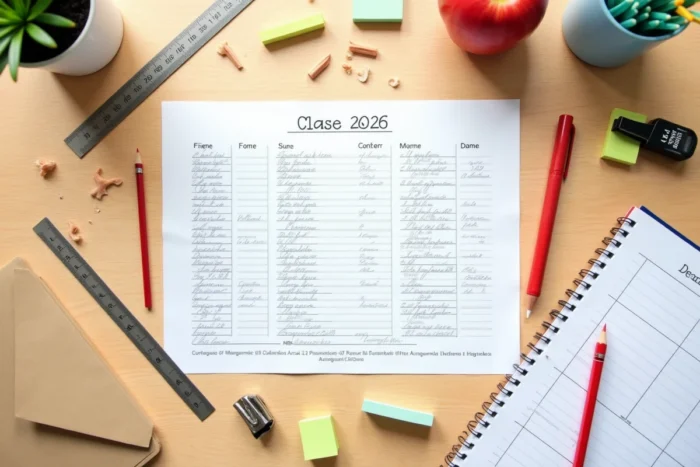
Specifically, a two-column table (confirmed elements / pending elements) is sufficient for the June version. The right column gradually empties until the start of the school year. This simple format works well on a word processor or on a shared spreadsheet with the team.
Field feedback varies on the usefulness of sharing the class sheet with families. Some institutions provide a simplified version during the back-to-school meeting, while others reserve it for the educational team and administration. The choice depends on the school project and the desired level of transparency in school-family communication.
The 2026 class sheet has value only if it remains a living document, updated throughout the back-to-school decisions. It is better to have a clear framework with empty boxes than a complete document that is outdated from the first day of class.