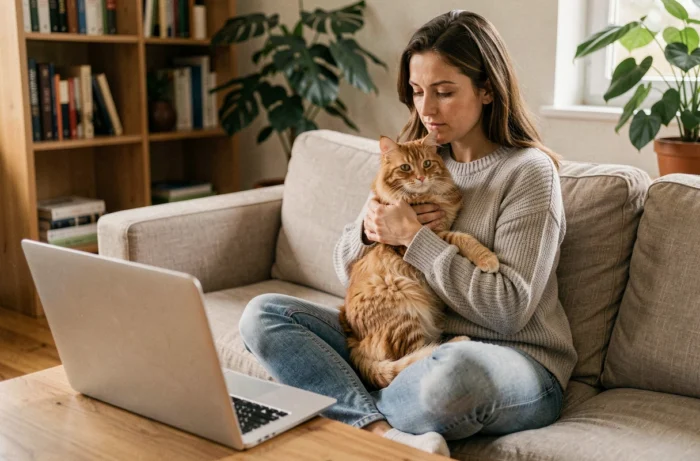
Since the decree of 5 May 2020, veterinary telemedicine has been governed by a regulatory framework in France. Pet owners can speak remotely with a veterinarian by video or phone, with arrangements that vary considerably from one service to another. However, the framework is still evolving, so the exact conditions of practice should be checked regularly.
Tele-advice, teleconsultation and remote monitoring: three different levels of service
The term “online veterinary advice” covers a wide range of services. Before booking an appointment, understanding the differences between these three levels can help avoid disappointment about what a professional can actually do remotely.
Tele-advice does not allow for diagnosis or prescriptions. It is a conversation, often by phone, in which the veterinarian advises the owner: Is an emergency visit needed? Should a symptom be monitored? Should the animal’s diet be adjusted? This service helps assess the situation, not resolve it.
A teleconsultation, on the other hand, involves a video call with an identified veterinarian. The animal must be visible on screen, and the professional may provide a clinical opinion, subject to certain regulatory conditions. Getting online veterinary advice on British & Co can help you understand this distinction before choosing the option that best suits your situation.
Remote monitoring is for following up on an animal that has already been examined at a clinic. The treating veterinarian checks how a treatment or recovery is progressing without requiring another trip for the animal.
- Tele-advice helps assess and triage a situation without involving a veterinary medical procedure
- Video teleconsultation provides a clinical opinion within a regulated framework, but cannot replace a physical examination
- Remote monitoring extends an in-person consultation that has already taken place, with the same veterinarian

Remote veterinary consultations: what a screen cannot replace
A camera cannot palpate an abdomen, listen to a heart murmur or take a blood sample. This is an inherent limitation, and no advances in video technology are likely to change that in the near future.
In practice, the veterinarian may conclude that an in-person examination is necessary. This is actually one of the most common outcomes of a teleconsultation: the professional observes the animal, listens to the owner, then refers them to a clinic or emergency service. This is not a failure of the system; it is how the system is meant to work.
Whether a prescription can be issued depends on the requirements for a clinical examination. A veterinarian who has not been able to physically examine the animal may be limited in their ability to prescribe certain treatments. This restriction protects the animal, even if it can sometimes frustrate an owner who is in a hurry to get a prescription.
Serious symptoms: a video call is not the right first step
An animal experiencing difficulty breathing, bleeding, sudden collapse or seizures needs emergency veterinary care, not a video appointment. If symptoms are serious, the priority is to contact an emergency service by phone (3115 in France) for directions to the nearest facility.
Waiting for a teleconsultation appointment in these situations can waste critical time. Remote consultations are useful before or after an emergency, not during one.
When online veterinary consultations offer real value
Some situations are well suited to remote consultations, and this is where the service truly proves its worth.
Behavioural concerns are a good example. If a dog develops separation anxiety or a cat starts urinating outside its litter box, the veterinarian can observe the animal’s environment directly through the owner’s camera. This can sometimes be more informative than an in-clinic consultation, where the animal may be stressed.
Remote consultations make it easier to monitor chronic conditions regularly. For an animal with diabetes or on long-term medication, regular video check-ins with the treating veterinarian make it possible to adjust a dose or spot a deterioration without making repeated trips.
Owners living in rural areas, far from the nearest veterinary clinic, can use tele-advice as a helpful first step. Finding out whether a trip is necessary before driving for an hour is a practical benefit.
Practical requirements for consulting a veterinarian online
The equipment needed is simple: a smartphone or computer with a camera, a stable internet connection and a quiet place where the animal can be handled in front of the screen.
- Prepare information about the animal in advance: breed, age, estimated weight, current treatments and vaccination history
- Record symptoms before the consultation if they come and go (limping, coughing, vomiting)
- Make sure there is enough light for the veterinarian to examine the mucous membranes, eyes or a skin lesion
- Keep the health record or previous prescriptions close at hand
The quality of the video connection directly affects how useful the consultation will be. A choppy video or broken-up audio makes it difficult for the veterinarian to work effectively. If the connection is poor, a simple tele-advice phone call will be more productive than an unusable video call.
Check the professional’s credentials
Any veterinarian offering remote consultations must be registered with the French National Order of Veterinarians. This registration can be verified. A service that does not provide the veterinarian’s identity or registration number should raise concerns for pet owners.
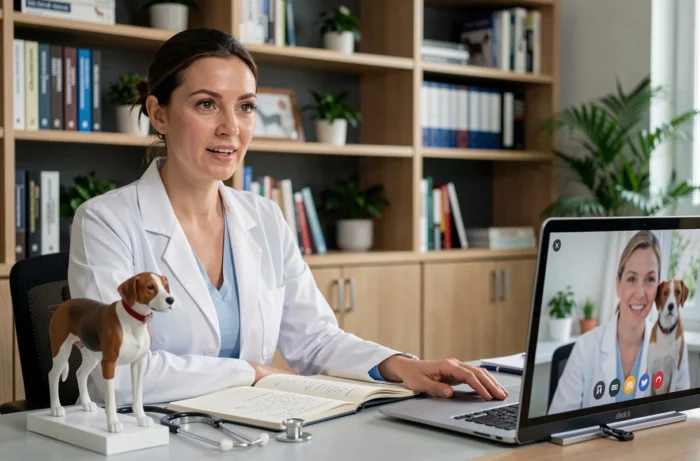
The regulatory framework for veterinary telemedicine in France continues to evolve. The conditions of practice, the procedures permitted remotely and the professional’s obligations may change from year to year. Before signing up with a platform, checking that the service complies with the regulations in force at the time of the consultation remains the most useful precaution—and the one people are least likely to take.