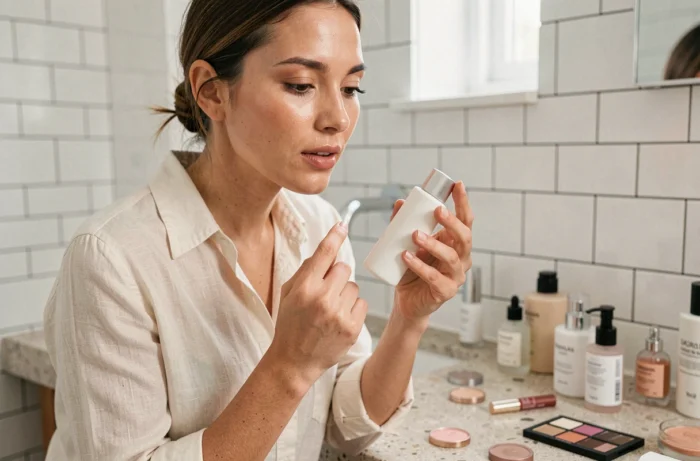
Each new school year brings its share of cosmetic launches, but the beauty innovations this month stand out for a common point: the merging of makeup and skincare. Rather than providing a comprehensive catalog, this article compares the launches that are redefining routines, identifies the hybrid formulas gaining ground, and highlights a European regulatory change that will alter how these products are presented online.
Makeup-skincare and technical skinimalism: what’s changing in the formulas
The boundary between makeup and skincare has never been so porous. Brands are no longer content to simply add a moisturizing active ingredient to a foundation: they are designing entire ranges around this dual function.
Erborian exemplifies this trend with its Set & Care range, launched in September 2026. It includes a foundation primer, a setting mist, and a mattifying loose powder, three products designed to extend makeup wear while adhering to a skincare logic. This is no longer a secondary marketing argument; it is the very concept of the range.
At the same time, the skinimalism trend is pushing towards more technical hybrid products. The back-to-school selections highlight lightweight textures, mattifying formulas without a drying effect, tubing mascaras, and tinted serums. In terms of actives, peptides, PDRN, and ectoine are featured in several launches. The goal is no longer to layer steps but to streamline the routine without sacrificing visible performance or skin comfort.
Among the news on the Babioles Beauté site, several of these hybrid formulas are already listed, allowing for real-time tracking of their availability.
Arrival of rhode at Sephora: a launch that restructures online distribution
The European expansion of rhode at Sephora, announced at the end of August 2026, goes beyond simply adding a brand to the catalog. Previously very dependent on its direct sales channel, rhode is moving to large-scale physical distribution in Europe. For consumers who shop online, this means access via the Sephora website, with its filters, reviews, and loyalty program.
This movement has consequences for the visibility of other brands. When a socially prominent brand integrates into a dominant retailer, it captures a share of the search traffic that previously benefited brands already present. For skincare-makeup brands like Erborian, coexisting with rhode on the same search results pages alters the competitive environment.
Comparison of notable beauty launches for the fall of 2026
The table below gathers the launches and trends documented this month, distinguishing their positioning and distribution channel.
| Launch / Trend | Category | Positioning | Main Channel |
|---|---|---|---|
| Erborian Set & Care | Makeup-skincare | Primer, setting mist, mattifying powder | E-commerce, Amazon, institutes |
| rhode at Sephora Europe | Skincare / makeup | Physical + online distribution via Sephora | Sephora (web and stores) |
| Tubing mascaras | Technical makeup | Long-lasting wear, water-removable | Multi-brand online |
| Tinted serums | Hybrid skincare-makeup | Light coverage + actives (peptides, ectoine) | Specialized sites, pharmacies |
Hybrid products dominate the back-to-school launches, whether they are tinted serums or complete ranges like Set & Care. High-visibility social partnerships, such as the arrival of rhode at Sephora, capture media attention, but the formulation innovations are more often found among skincare brands.

European Directive 2024/825: what’s changing for online beauty claims
A regulatory change will come into effect on September 27, 2026 with the European directive 2024/825. This text targets generic environmental claims used to present cosmetic products online.
Statements like “environmentally friendly” or “eco-responsible” will need to be backed by recognized certification. For e-commerce sites that list new beauty products, this means updating product sheets and marketing arguments.
- Self-awarded labels without third-party organizations will no longer be able to serve as selling points on online product sheets
- Claims like “natural” or “green” must be supported by verifiable and public evidence
- Environmental comparisons between products must rely on transparent methodology
For consumers who purchase their beauty products online, this directive will change the presentation of product sheets on most merchant sites in the coming weeks. Brands that already have strong certifications (Ecocert, Cosmos) will be favored over those relying on vague formulations.
Emerging actives: peptides, PDRN, and ectoine in fall skincare
The beauty innovations of September are not limited to makeup. In terms of skincare, three actives are returning in the formulations highlighted by specialized media.
Peptides, already present for several seasons, are becoming more precise in their use. They now appear in targeted serums rather than in general creams. PDRN (polynucleotides) and ectoine, less known to the general public, are integrated into formulas aimed at skin repair and protection against oxidative stress.
These actives remain difficult to compare between brands: concentrations are not always listed on packaging, and testing protocols vary from one laboratory to another. Before choosing a serum based on PDRN or ectoine, checking the complete INCI list remains the most reliable reflex.
This month’s launches reveal a clear trend: routines are shortening, but each product incorporates more technology. The directive 2024/825 will accelerate this sorting by making superficial claims harder to maintain on product sheets.