
Fertility in France is around 1.55 children per woman according to the latest data from Insee, a historic low. This demographic reality reflects a growing difficulty in envisioning a sustainable family project. Building a fulfilling family life today requires concrete trade-offs regarding time, domestic space, and the distribution of responsibilities between parents.
Remote Work and Family Organization: What Home Office Really Changes
Remote work has reshuffled the logistics of family life. We observe that the presence of a parent at home during school hours profoundly alters the management of meals, school runs, and child supervision.
A common pitfall: confusing physical presence with parental availability. Working from home does not mean absorbing domestic tasks simultaneously. Clearly separating work hours and family life remains the condition for the arrangement to benefit everyone.
Several studies reported by Eurofound on remote work in Europe highlight a risk of permeability between professional and personal life that generates marital stress. We recommend consulting the family page of Ananas Et Asanas to delve into strategies for balancing parenting and household organization.
A simple protocol works: define a sanctified time slot (even short) where the parent working remotely is not to be disturbed, and a symmetrical slot where they dedicate themselves exclusively to the children. This clear alternation reduces the mental load for both partners.

Task Distribution in Couples: Going Beyond the Declarative
The domestic load remains the primary source of tension in two-parent families. Surveys by Drees on paternity leave show that fathers who get involved early in baby care maintain a higher level of participation as the child grows.
The issue is not the theoretical sharing. Most couples claim to aim for equity. The gap lies in the cognitive load: who anticipates the medical appointment, who monitors the diaper stock, who plans the week’s meals.
Making the Mental Load Visible
We use a simple tool in parental support:
- List every micro-task related to the children and the home for a week, without filtering (buying snacks, signing notebooks, making appointments, laundry)
- Assign each task to the parent who initiated it (not the one who executed it, the one who thought of it first)
- Redistribute not the tasks themselves, but the complete areas of responsibility (one parent fully manages health, the other school administration)
Delegating an entire area reduces the mental load more than sharing each task 50/50. The parent responsible for an area makes decisions without needing validation from the other, which eliminates back-and-forth.
Family Activities: Prioritizing Regularity Over Intensity
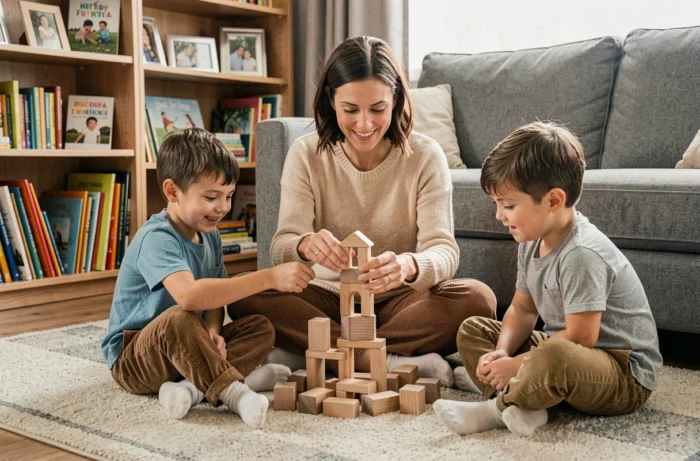
Family rituals require neither a budget nor heavy logistics. What matters is predictability. A child who knows that Wednesday evenings are dedicated to a board game or a walk develops a measurable sense of emotional security.
We find that families that function best do not multiply activities. They choose two or three, anchor them in the week, and stick to them.
Criteria for Choosing a Sustainable Family Activity
- The activity must be suitable for the youngest child in the household without boring the older ones (simple cooking, bike rides adjustable in distance, reading aloud with age-appropriate texts)
- It should not depend on expensive equipment or long travel, otherwise it will be abandoned at the first logistical constraint
- It must include a time for verbal exchange: passive activities (shared screens) do not produce the same effect on family cohesion
A family ritual held every week is worth more than an exceptional outing once a month. Regularity builds family memory, not intensity.
Parental Stress and Couple’s Health: Two Related Issues
Chronic parental stress degrades the marital relationship even before parents become aware of it. Inflation and housing costs exacerbate this pressure: according to recent analyses reported by the press, the difficulty in projecting financially is cited among the barriers to expanding the family.
The common temptation is to sacrifice couple time for the benefit of the children. Maintaining a marital space distinct from parental space is not a luxury. It is a factor of stability for the entire household.
Preserving the Couple Relationship with Young Children
A daily exchange of ten minutes between partners, without logistical topics (no planning for the next day, no shopping list), is enough to maintain an active emotional bond. The content matters less than the regularity.
When financial or professional stress sets in, we recommend verbalizing the problem in concrete terms rather than vague feelings. Saying “we have exceeded the weekly food budget” opens an operational discussion. Saying “I am exhausted” without context generates helplessness in the partner.
Blended families and co-parenting configurations, increasingly recognized by recent French jurisprudence on multi-parenting, add a layer of complexity. Each reference adult must have a clear decision-making scope to avoid legitimacy conflicts in front of the child.
A fulfilling family life does not rely on a single model. It is built on repeated micro-decisions: who does what, when we meet, how we talk about money and fatigue. These daily trade-offs, regularly adjusted, produce more stability than any grand theoretical educational project.