
A dress that works at the office and on the weekend relies on three technical parameters: the construction of the cut, the behavior of the material after several hours of sitting, and sufficient chromatic neutrality to absorb very different accessories. We will detail these parameters by focusing on choices that last over time.
Weight and drape: materials that don’t betray at the end of the day
The first filter for selecting a versatile dress is not the cut, but the fabric. A material that wrinkles after two hours of sitting disqualifies the piece for professional use, regardless of its style.
We recommend targeting polyester-viscose crepes or blends containing less than five percent elastane. These fabrics offer a fluid drape without crease memory. Thick crepe maintains its shape even in hot weather, whereas fine jersey marks every sitting.
For autumn, the trend towards soft tailoring observed in the fall 2026 collections confirms this shift: technical materials are replacing rigid fabrics. Lightweight blazers and midi dresses in semi-structured fabric dominate workwear proposals. This same fabric, worn with white sneakers on Saturday, changes radically without effort.
The challenge of finding the perfect dress for the office and the weekend often comes down to touch in-store: a fabric that returns to place when crumpled in hand will last the day without issue.
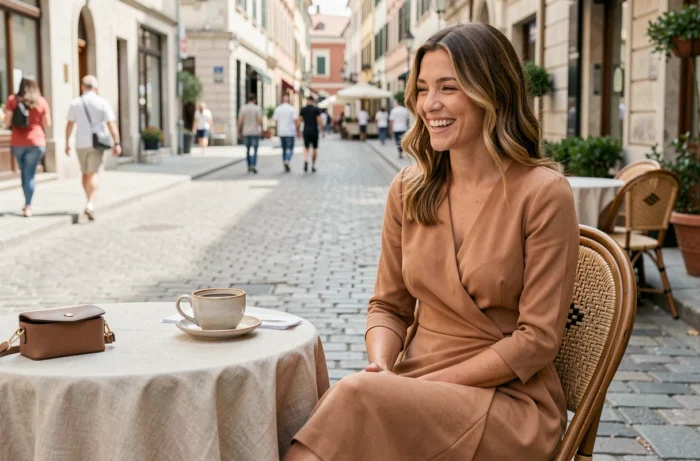
Midi dress and knee-length: which cut holds both registers
The midi length (between the calf and the knee) stands out as the most versatile format. It remains professional without appearing strict and works with flat sandals on the weekend as well as with heels at the office.
Straight cut versus wrap cut
The slightly flared straight dress under the waist accommodates all body types. It does not require a belt to structure the silhouette, which reduces the number of accessories to carry.
The wrap cut, very present in fashion recommendations, poses a concrete problem: the neckline shifts throughout the day. At the office, this requires constant adjustments. If you are attached to this style, prefer models with a stitched faux wrap (the visual effect without the actual opening).
Sleeves and neckline: details that tip the register
A three-quarter sleeve or a straight short sleeve works everywhere. Balloon sleeves or ruffled sleeves steer the piece towards casual and complicate wearing a blazer over it.
The boat neckline or classic round neck remains the most neutral. They accept a choker necklace for the office and dangling earrings for the weekend without visual conflict.
Colors for a versatile dress: beyond black and navy
Burgundy and dusty pink are the two shades to consider this season. The fall 2026 trends confirm the return of burgundy as a strong color at the office, while pink (in its muted variations, not bright pink) settles on runways and in lifestyle press.
Black remains a safe choice but has a rarely mentioned flaw: it amplifies the formal aspect. A black dress at the office is a given. The same black dress on Saturday in a café gives a look that is too dressed up, unless compensated with very casual accessories.
Here are the palettes that truly work across both registers:
- Burgundy, forest green, glacier blue: colors deep enough for the office, vibrant enough for the weekend
- Beige, camel, taupe: neutral yet warm, they pair well with gold jewelry as well as with a canvas bag
- Lavender, dusty pink, terracotta: shades that emerge this season and bring brightness without tipping into festive
We observe that moderately saturated colors are the most versatile. Too light, the fabric shows stains. Too dark, it confines to a formal register.
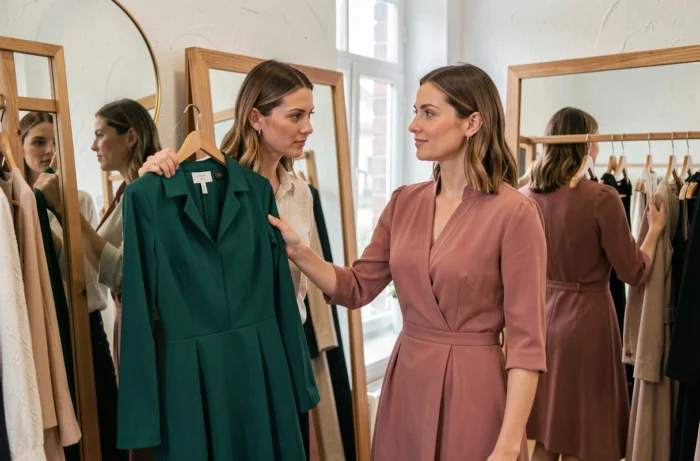
Office and weekend accessories: the real lever of transformation
The dress does not change. It is the pieces around it that shift the register. This principle, simple in theory, requires a rigorous selection of accessories to work without multiplying bags.
A structured lightweight blazer transforms any midi dress into a professional outfit. Slightly oversized models, in line with the soft tailoring of fall 2026, add structure without rigidity. Remove the blazer, add a soft leather crossbody bag: the dress becomes a weekend piece.
Shoes are the second lever. Loafers or flat derbies on Saturday, block-heeled pumps on Tuesday: the same dress produces two distinct silhouettes. We advise against stilettos, which anchor the outfit too much in a dressed-up register and limit versatility.
Jewelry: measured layering
The 2026 trends highlight layered jewelry (brooches, earrings, thin bracelets). At the office, a single level of jewelry suffices: discreet earrings or a watch. On the weekend, layering works without restraint.
- Office: a pair of earrings, no visible necklace, simple watch
- Weekend: layered necklace, bracelet, dangling earrings, brooch on the collar
- Quick transition: adding a scarf tied to the bag or wrist changes the energy of the outfit in seconds
Pleated dress fall 2026: the piece to watch
The return of the pleated dress noted by fashion press for fall 2026 deserves attention. Pleats have a technical advantage: they do not wrinkle (the pleat is the resting shape of the fabric). A midi pleated dress in a sober color moves from the office to brunch without any adjustments.
The limit: very fine pleats (Issey Miyake style) can appear too dressed up for casual use. Prefer wider pleats, more relaxed, that move with the body without a cocktail effect.
The choice of a versatile dress boils down to a fabric that does not mark, a midi length, a moderately saturated color, and two sets of accessories. The piece itself remains stable; it is its environment that shifts it from one register to another.