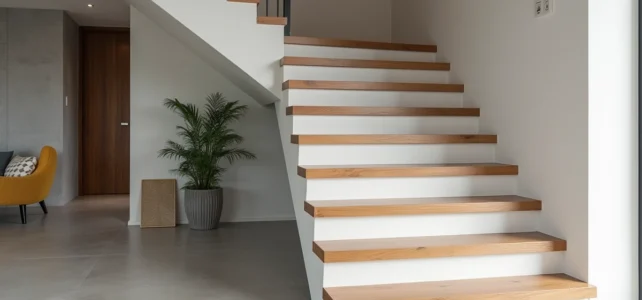
A raw concrete staircase that echoes with every step, worn treads that slip as soon as you wear socks, a dark stairwell that no one wants to traverse: these situations are regularly encountered during renovations. The choice of materials to dress a staircase is not just about decoration. It affects acoustic comfort, daily safety, and the lifespan of the structure.
Technical constraints before the aesthetic choice of staircase cladding
Before flipping through catalogs of shades or textures, three on-site parameters are checked that automatically eliminate certain options. The existing support (concrete, metal, wood) dictates the adhesives, fasteners, and the acceptable thickness of the covering without altering the regulatory step height.
Regulations require a handrail for more than two risers and guardrails for four risers or more, with a spacing of less than 4 cm between elements to prevent a child from passing through. These obligations directly influence the choice: a cladding that is too thick on the tread edge can reduce the tread depth below the comfort threshold, and a smooth material without anti-slip treatment poses a safety issue that style will not compensate for.
Weight is also a consideration. Installing porcelain stoneware tiles or natural stone on a lightweight wooden staircase requires checking the load-bearing capacity. Neglecting this point risks creaking or even deformation of the stringers. To delve deeper into this topic, one can consult stair materials on Conseil Habitat which details suitable support-covering combinations.
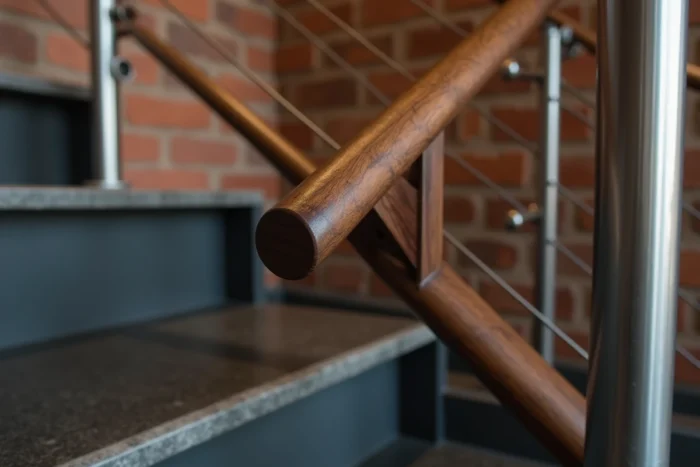
Solid wood or laminate for stair treads: the concrete match
Wood remains the first instinct, and for good reasons. Oak withstands heavy traffic without flinching, beech offers a light appearance that visually enlarges a narrow stairwell, and spruce is suitable for tight budgets with more frequent maintenance in return.
Laminate mimics wood but cannot be sanded in case of deep scratches. This is the main limitation. On a heavily used staircase (family with children, daily passage with shoes), the decorative layer of an entry-level laminate wears out in a few years. Solid wood, even damaged, can be sanded and refinished.
On the other hand, laminate offers a clear advantage in terms of occasional moisture and color consistency. Feedback varies on this point depending on the quality of the product: high-pressure laminate performs significantly better than a standard model.
Trendy finishes and colors on wood
The trends for 2025-2026 lean towards natural shades like terracotta, mocha, or sand, often paired with wood left in a raw or simply oiled state. The idea is to keep the visible grain rather than hide it under a glossy varnish. We also see treads painted in blue or natural green on the risers, with the tread surface left in light wood to create a decorative and safe contrast.
Natural stone and tiles on interior stairs: when it’s worth it
Stone and tiles are justified in specific configurations. A staircase on a concrete slab on the ground floor, a heavily trafficked passage (direct entry from the outside), or an architectural style that calls for a mineral material.
- Full-body porcelain stoneware resists impacts and can be cleaned with water without treatment, but each tread must be cut precisely to avoid dangerous lips at the tread edge
- Natural stone (slate, travertine, granite) provides a unique character due to variations in veining, with superior wear resistance compared to most other options
- Polished concrete offers a contemporary and monolithic look, but requires application by an experienced professional to ensure adhesion and avoid cracks on the tread edges
The main pitfall with these materials: slipperiness. A structured, bush-hammered, or softened (not polished) finish is always chosen for tread surfaces. A polished tile floor in a living room works, but on a staircase, it poses a risk of accidents.
Vinyl and carpet for stairs: underestimated solutions in renovation
Technical vinyl and carpet suffer from a dated image. In practice, these materials effectively solve two problems that wood or stone do not address as well: noise and thermal comfort underfoot.
A concrete staircase dressed with LVT vinyl tiles eliminates resonance and provides a non-slip surface without additional treatment. Installation is done on the existing support with minimal bulk, preserving the step dimensions.
Carpet, on the other hand, is particularly suitable for floors where people walk barefoot. It absorbs footstep noise (a real issue in multi-story houses with bedrooms below) and secures descents for young children. The weak point remains maintenance: regular cleaning is essential to avoid dust accumulation in the fibers.
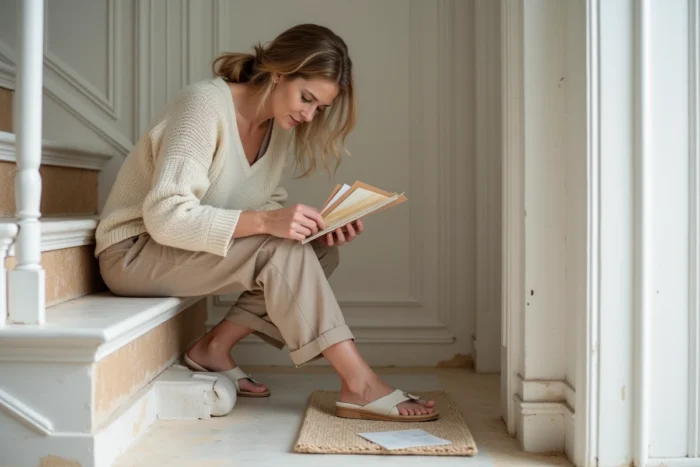
Metal and glass on stairs: combining materials for a unique look
Rather than choosing a single material, the most successful designs combine two or three materials with distinct roles:
- Metal structure (powder-coated steel or brushed stainless steel) for visual lightness and mechanical strength
- Solid wood treads for walking comfort and acoustics
- Tempered glass guardrails to let light through without sacrificing safety
- Perforated or open metal risers to lighten the overall look in compact spaces
Glass on the treads themselves remains a demanding technical option. It requires treated anti-slip laminated glass, with a thickness that increases the budget. Glass works better as a guardrail than as a tread surface for most residential projects.
Metal alone, without wood cladding on the treads, produces a metallic resonance with each step. It is recommended as a structure or finishing element, rarely as the main tread surface in a lived-in home.
Each material solves one problem and creates another. The final choice depends on the existing support, the level of traffic, and the long-term maintenance budget, not just the appearance in a magazine photo.