
Choosing an electric hedge trimmer involves balancing several technical parameters, the impact of which on cutting results and user comfort varies significantly from one model to another. Blade length, tooth spacing, weight, noise level: each criterion carries different weight depending on the hedge to be maintained and the garden configuration. Rather than listing generalities, this article compares the data that truly separates a suitable electric hedge trimmer from a poor purchase.
Noise level and local regulations: the criterion that no one quantifies
Most selection guides compare power and blade length. The noise generated by the device is rarely considered in relation to regulatory constraints, even though it concretely conditions the usage times.
In France, national law does not set specific hours for noisy work. Article R.1336-5 of the Public Health Code prohibits any noise that, by its duration, repetition, or intensity, disturbs the tranquility of the neighborhood. Specific hours depend on prefectural or municipal orders.
Some municipalities allow trimming on weekdays from 8:30 AM to 12 PM and from 2:30 PM to 7:30 PM, with shorter hours on weekends. Others completely prohibit the use of hedge trimmers on Sundays and public holidays. A corded electric model produces significantly fewer decibels than a gas model, which effectively widens the usage window without risking conflict with neighbors.
A relevant comparison on taille-haie-electrique.com allows filtering models based on this criterion, often absent from product sheets in large stores.
Corded or battery-powered electric hedge trimmer: a comparative table of real differences
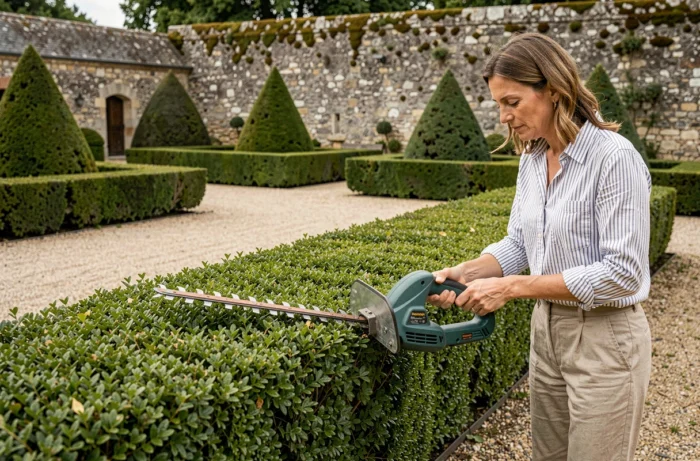
The distinction between corded and battery is often reduced to “with or without cord.” The technical differences deserve a closer look.
| Criterion | Corded | Battery (lithium-ion) |
|---|---|---|
| Average weight | Lighter (no built-in battery) | Heavier by several hundred grams |
| Runtime | Unlimited (plugged in) | Variable depending on battery capacity |
| Range | Limited by extension cord | Total freedom of movement |
| Noise level | Low | Low to moderate |
| Motor power | Constant | Decreases at the end of charge on some models |
| Maintenance | Minimal (blade only) | Blade + battery charge cycle management |
| Entry price | The most accessible | Significantly higher (battery included) |
The corded option remains the most rational choice for a modest-sized garden with an outdoor outlet nearby. The battery model is justified when the hedge exceeds twenty linear meters or when electrical access is distant.
Tooth spacing and cutting diameter: the underestimated parameter
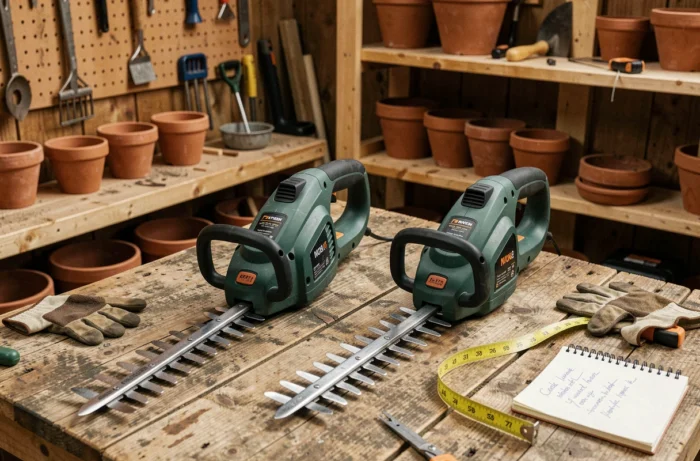
Blade length attracts attention, but it is the tooth spacing that determines the maximum diameter of the branches being cut. A wide spacing is suitable for country hedges with thick branches. A narrow spacing produces a cleaner cut on hedges of thuja, laurel, or boxwood, where the shoots remain fine.
- Narrow spacing (less than two centimeters): suitable for regularly trimmed evergreen hedges, precise cut on softwood
- Medium spacing (around two to three centimeters): versatile, suitable for most mixed garden hedges
- Wide spacing (beyond three centimeters): reserved for free or semi-free hedges with woody branches
A common mistake is to buy a hedge trimmer with wide teeth for a thuja hedge. The result: branches get stuck between the teeth, a motor that struggles, and an uneven cut that browns the tips.
Blade length and weight: finding the balance point
A longer blade covers more surface area with each pass. However, it adds weight to the device and reduces maneuverability in corners or on narrow hedges. Beyond a certain blade length, muscle fatigue increases significantly during sessions longer than half an hour.
For a low hedge (less than one meter), a short blade is sufficient and offers superior precision. For tall hedges requiring work at arm’s length, the weight of the entire unit becomes the limiting factor before the blade length.
- Low hedge, frequent maintenance: short blade, minimal weight, maximum maneuverability
- Medium hedge (one to two meters): intermediate length blade, weight-coverage compromise
- Tall or long hedge: prefer a pole model or a lightweight hedge trimmer with a rotating handle
The rotating or adjustable handle is a criterion often overlooked. It allows trimming the sides and top of the hedge without straining the wrist. On entry-level models, this function is absent, forcing the adoption of tiring postures.
Professional electric ranges: a game-changing segment
Electric ranges designed for intensive use are gaining power in the market. The lifespan of batteries and the reliability of brushless motors are becoming as crucial parameters as blade length for regular users.
The after-sales service network is a concrete purchasing criterion in this segment. A brushless motor lasts longer, but in case of electronic failure, repairs go through the manufacturer. Checking the availability of spare parts and the proximity of an authorized repairer before purchase prevents ending up with an unusable device after two seasons.
A well-chosen electric hedge trimmer meets the needs of the vast majority of private gardens. Gas models are only justified for very thick hedges or daily professional use. The decisive criterion is rarely raw power: it is the match between tooth spacing, the weight of the device, and the actual morphology of the hedge that separates a suitable tool from a regrettable purchase from the first trim.