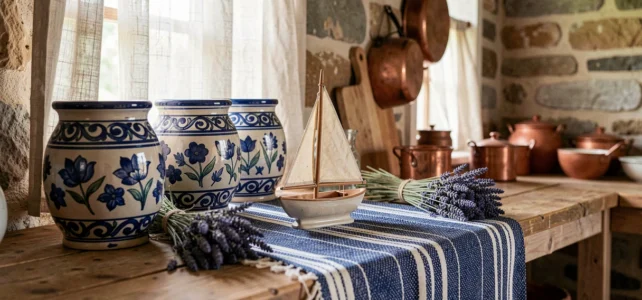
Pornic earthenware bowls, artisanal leather goods from Morbihan, linen textiles from Finistère: the range of Breton accessories has significantly expanded in recent years. Comparing product categories, their materials, and their origins allows for informed choices rather than succumbing to impulsive purchases of soulless souvenirs.
Comparison of Breton accessory categories by use and material
Not all families of Breton accessories meet the same needs. The table below summarizes the main available categories, their primary use, and the most common materials.
| Category | Main Use | Common Materials | Frequent Origin |
|---|---|---|---|
| Dinnerware (bowls, plates) | Table art, gift | Earthenware, stoneware | Pornic (Loire-Atlantique) |
| Textiles (tea towels, cushions) | Interior decoration, kitchen | Cotton, linen | Finistère, Morbihan workshops |
| Leather goods (bags, belts) | Fashion, everyday accessory | Locally tanned leather | Morbihan (Monterblanc, Vannes) |
| Jewelry and pins | Personal style, collection | Metal, enamel, wood | Independent creators Brittany |
| Decorative objects (lighting, driftwood) | Interior layout | Driftwood, stone, glass | Finistère coasts |
What stands out from this overview is that each category relies on localized materials and craftsmanship. Breton dinnerware remains concentrated around Pornic, while artisanal leather goods are gaining ground in Morbihan.
The creators listed on Breizheo cover several of these families, making it easier to compare products for the same decoration or layout project.
Personalized Breton bowl: why this accessory dominates sales
The Breton bowl remains the best-selling accessory in the entire regional decorative universe. More than one million Breton bowls are sold each year, mainly made in Pornic. This sales volume places this item far ahead of other categories in terms of distribution.
Personalization (name, chosen pattern) largely explains this success. A customizable earthenware bowl works equally well as a gift and as a daily decorative element on a kitchen shelf.
However, this popularity has a downside: competition among manufacturers is very strong, and quality varies significantly from one workshop to another. A thick stoneware bowl made artisanally does not have the same durability as an industrial model simply decorated with a Breton pattern.
- Check for the label “made in Pornic” or “made in Brittany,” as some bowls are produced outside the region with a simple applied Breton decoration
- Prefer stoneware or thick earthenware for everyday use (resistance to dishwashers and thermal shocks)
- Compare personalization options: some workshops offer hand painting, while others use transfer printing, resulting in very different durability
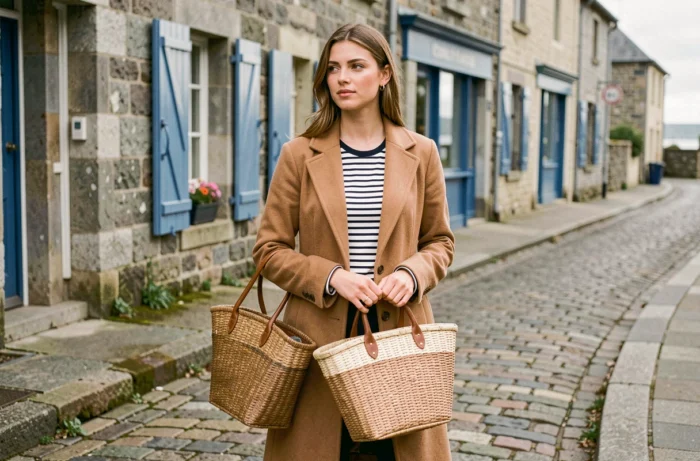
Breton leather goods and fashion accessories: responsible craftsmanship on the rise
The segment evolving the fastest since 2024 is Breton artisanal leather goods. Workshops like Gueule de Cuir in Monterblanc (Morbihan) illustrate this trend: local production, responsible leathers, entirely handmade.
This positioning contrasts with more traditional Breton fashion accessories (embroidered caps, patterned socks). The difference lies in the product’s durability and the traceability of materials.
The market for creators in Vannes, documented by Ouest-France, regularly brings together artisans offering jewelry, bags, and lighting. These markets allow for checking the quality of craftsmanship before purchase, an advantage that online shops cannot offer in the same way.
In contrast, Breton pins and stickers (like “Born to be breton”) remain entry-level products, often mass-produced. Their appeal is more identity-based than decorative, and their lifespan is nothing compared to a locally tanned leather bag.
Breton interior decoration: which accessories truly transform a room
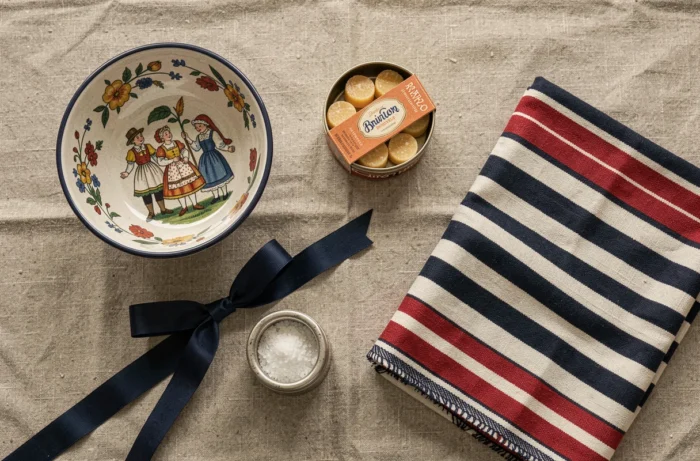
Between a triskell-patterned tea towel and a driftwood light fixture, the impact on a room’s ambiance is not the same at all. Breton textiles (tea towels, placemats, cushions) provide a subtle identity touch but remain supplementary elements.
The pieces that truly change the atmosphere of an interior are volumetric objects: lighting made from driftwood collected from the Finistère coasts, artisanal ceramics used as vases or centerpieces, or frames and illustrations by local artists.
- A driftwood light fixture placed on a low piece of furniture is enough to anchor a living room in a coastal ambiance without overloading with maritime motifs
- Textiles work better in small touches (a cushion, a table runner) than in accumulation, which risks tipping into excessive theming
- The colors to prioritize remain navy blue, off-white, and natural stoneware tones, which integrate into most contemporary interiors
A single well-chosen artisanal object has more impact than a collection of generic decorative accessories. This is the lesson that emerges from current trends driven by Breton creators: fewer products, but durable pieces made locally.
The “Les Incontournables” show, dedicated to creative brands from the West and scheduled for 2026 in Nantes, confirms this direction. Breton accessories are no longer limited to flags and stickers. Breton workshops are now developing objects designed to last, made with a focus on local production and material traceability.