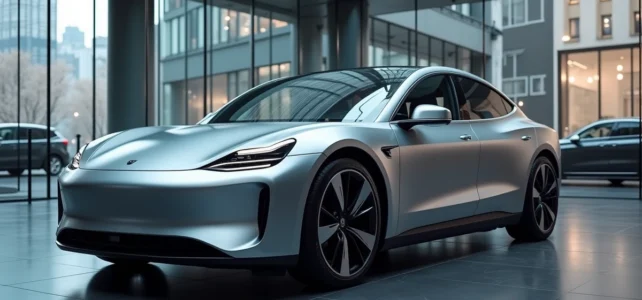
The French automotive market is undergoing a restructuring phase that goes beyond mere fluctuations in sales volumes. The first half of 2026 reveals contradictory dynamics between new and used vehicles, while niche segments, such as microcars, are reshaping urban usage. What indicators allow us to read this ongoing transformation?
New vs Used: Two Markets That Tell Different Stories
The recovery of the new vehicle market in France coincides with a slight downturn in the used vehicle market. This dissociation deserves attention, as it reflects a structural change rather than just a simple post-shortage catch-up effect.
| Indicator | New Vehicles (H1 2026) | Used Vehicles (H1 2026) |
|---|---|---|
| Volume Trend | Upward recovery | Slight decline |
| Share of Electric | Regularly increasing | Still marginal |
| Demand Driver | Regulatory renewal, social leasing | Household budget constraints |
| Tax Pressure | Tighter CO2 penalties and weight taxes | ZFE restrictions on older models |
The new segment benefits from institutional levers: the third edition of social leasing, scheduled for mid-July 2026, directly targets low-income households to accelerate the transition to electric vehicles. In contrast, the used market faces the dual pressure of low-emission zones and an aging fleet, where depreciation no longer offsets usage costs.
Analyses published in MaxiScoop’s auto universe confirm that this new/used divergence forces distributors to rethink their profitability model.
Electric Microcars: A Laboratory for Urban Mobility

The light quadricycle segment is rarely mentioned in automotive overviews. However, it concentrates a phenomenon of electrification that is much faster than the rest of the market. In 2025, 75% of microcar sales in France were electric models.
This figure places quadricycles ahead of all other segments, including city cars and compact SUVs. Three factors explain this shift:
- Very low usage costs (home charging, minimal maintenance, no traditional registration), making electric vehicles immediately competitive against combustion engines in this format
- A demand driven by low-emission zones, where these vehicles can circulate without restrictions, and by young drivers from the age of 14
- A manufacturer offer that has focused on electric, reducing the thermal choice to a few residual models
This micro-segment functions as a laboratory for usage in urban micro-mobility. Charging behaviors, short daily trips, and acceptance of all-electric vehicles by diverse audiences (teenagers, seniors, last-mile delivery drivers) foreshadow possible developments in other vehicle categories.
2026 Ecological Penalty: Thresholds That Change the Game for SUVs
The tightening of the ecological penalty directly impacts purchasing choices. The triggering thresholds for the CO2 penalty continue to decrease each year, expanding the scope of taxed vehicles. The weight penalty, introduced for models exceeding a certain threshold, now affects a significant share of SUVs and high-end sedans.
For buyers, the consequence is arithmetic: on certain models, the cumulative CO2 penalty and weight penalty can exceed several thousand euros. Manufacturers are responding by lightening their platforms or offering plug-in hybrid versions that just meet the thresholds.
The SUV segment remains the best-selling in France, but its internal composition is evolving. Compact and hybrid models are gaining ground against larger thermal vehicles. This shift is not driven by aesthetic preference: it is taxation that is reconfiguring the offer.
Corporate Fleets and Accelerated Electrification
Fleet managers are facing additional regulatory pressure. The obligations to green fleets, combined with tax benefits for electric vehicles (exemption from TVS, increased depreciation), are massively steering orders towards electric and plug-in hybrid vehicles.
Field reports show that the main obstacle remains on-site charging infrastructure, not the cost of the vehicle itself. The installation of charging stations at companies, connection delays to the grid, and managing peak consumption are the real operational issues for fleets in transition.
Decarbonization of the Vehicle Fleet: The Conversion Bonus in Question
The debate over the conversion bonus resurfaced in early July 2026. Some players in automotive financing believe that the priority should be to decarbonize the existing fleet, not just to support new vehicle sales.
The nuance is significant. The French vehicle fleet is still predominantly composed of older thermal vehicles. Subsidizing the purchase of a new electric vehicle benefits solvent households but does not remove the most polluting models from circulation. A rethought conversion bonus would target the effective scrapping of older vehicles, regardless of the type of vehicle purchased as a replacement.
This reflection comes as social leasing captures an increasing share of public schemes. The coexistence of these two mechanisms (social leasing for new vehicles, conversion bonus for phasing out old thermal vehicles) raises questions about their budgetary articulation.
The first half of 2026 outlines a French automotive market with multiple speeds. Data shows that the transition is not only played out in terms of powertrains but also in taxation, charging infrastructure, and public aid schemes. The restructuring of the new and used markets in opposite directions remains the most telling signal of this pivotal period.