
On one side, we have a brand new Galaxy A56, and on the other, a refurbished Galaxy S23, with both costing about the same. The instinct would be to rush for the S model due to its premium label. However, when we really compare the remaining software support, repairability, and total cost over three years, the choice between Samsung Galaxy A and S becomes less obvious than it seems.
Recent Galaxy A or refurbished Galaxy S: the real calculation to make
Let’s take a concrete situation. A recent Galaxy A, bought new, benefits from its entire update cycle. A Galaxy S from two or three generations ago, even refurbished in good condition, has already consumed part of that cycle. Feedback varies on this point depending on the exact model, but the remaining software support weighs as much as the purchase price in the equation.
Repairability also plays a role. An older S model sometimes uses parts that are less available or more expensive to replace (curved screen, specific glass back). A recent Galaxy A, with its simpler construction, is generally cheaper to repair. Over three years of use, replacing a screen or battery can significantly impact the total budget.
Before making a decision, it’s worth taking the time to compare the differences between Samsung Galaxy A and S based on the criteria that truly matter for daily use.

Photo and optical zoom: the only difference the Galaxy A can’t match
It is often said that recent Galaxy A models are getting closer to the S in photography. This is true for daytime shots in automatic mode, where the gap has significantly narrowed. The main sensor of a high-end Galaxy A produces sharp and well-exposed images in most situations.
Where it falls short is in the telephoto lens. The Galaxy S models include an optical zoom that the Galaxy A lacks. Specifically, if you’re photographing a sports match from the stands, a performance from the back of a hall, or an architectural detail while traveling, the S series maintains a clear advantage. The digital zoom of the Galaxy A quickly degrades the image beyond moderate magnification.
For night photography, the S also excels thanks to more advanced software processing and a larger main sensor. If photography is a secondary use (social media, documents), a Galaxy A is more than sufficient. If it’s a central use, the S remains the best choice.
Wireless charging, DeX, and connectivity: what the Galaxy A gives up
We don’t always think about these features at the time of purchase, but they change the daily experience. Here’s what the S series retains and the A series leaves aside:
- Wireless charging: the Galaxy S offers this, while recent Galaxy A models are limited to wired fast charging. If you use a charging pad at your desk or bedside, this is a non-negotiable criterion.
- Samsung DeX: the ability to connect the smartphone to a monitor to use it as a secondary computer. Available on the S, absent from the A.
- Reverse power sharing: charging earbuds or a smartwatch by placing the accessory on the back of the phone. Reserved for the S range depending on the models.
If none of these functions correspond to a real need, the Galaxy A makes no troublesome compromises. This is a point to honestly evaluate before paying the premium for the S range.
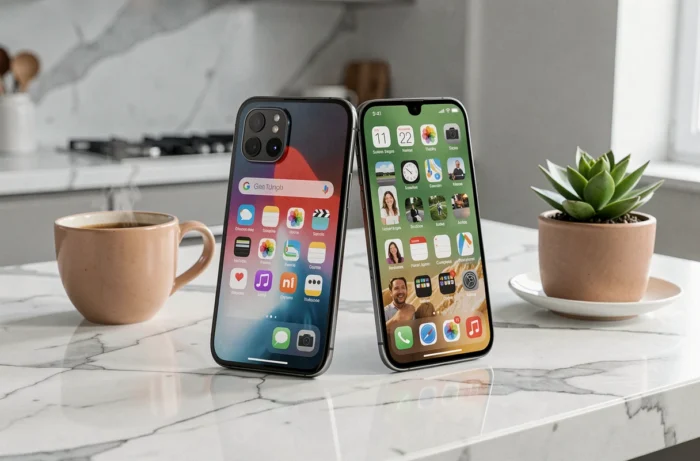
Screen and battery life: where the Galaxy A surprises
The Galaxy A models have stepped up in terms of screen and battery life. Recent models in the A series feature bright AMOLED displays, with generous diagonals and smooth refresh rates. For web browsing, videos, or daily scrolling, the screen experience of a recent Galaxy A rivals that of an S.
On the battery side, Galaxy A models often benefit from a larger capacity than the S at equivalent sizes. The less energy-hungry construction (processor optimized for efficiency rather than raw power) extends battery life. You can easily get through a full day, sometimes more, with mixed usage.
The difference lies in the finish. A Galaxy S uses more premium materials (titanium on some Ultra models, reinforced glass, more refined finishes). You can feel it in hand. The Galaxy A remains plastic or less premium glass, which does not affect usage but alters the daily perception.
Galaxy A vs S: decision grid based on actual usage
Rather than comparing technical specifications line by line, it’s better to reason by usage profile:
- Main usage calls, messaging, social media, browsing: the Galaxy A covers everything without notable compromise. The premium for an S is not justified.
- Regular photo usage with a need for zoom (travel, events, children in motion): the telephoto lens of the Galaxy S makes a daily difference.
- Office ecosystem (DeX, wireless charging, connected accessories): the Galaxy S remains the only one to offer these functions.
- Tight budget but desire for durability: a new Galaxy A with full software support protects better than a refurbished Galaxy S at the end of its update cycle.
The positioning between the two ranges has remained stable for several years. The Galaxy A is gaining ground on screen and battery life. The Galaxy S maintains its lead in photography, premium connectivity, and materials. The right choice depends on the criterion you refuse to sacrifice, not on an abstract hierarchy between the two series.