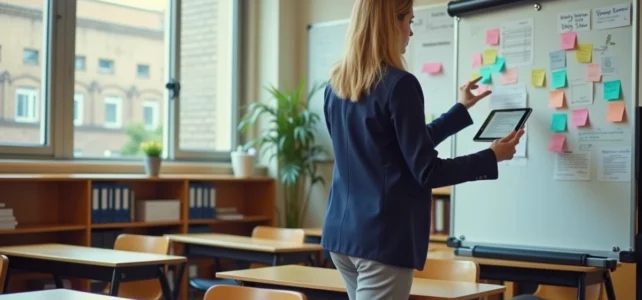
Organizing your class means structuring a framework that lasts from September to July without relying solely on the goodwill of the first few weeks. In 2026, this organization must incorporate a new constraint: the modification of hourly volumes in cycle 2, which redistributes time between French, mathematics, and artistic education starting from the new school year. Any timetable built on the old grids becomes obsolete.
New hourly volumes in cycle 2: what the 2026 decree changes in the timetable
A decree published in July 2026 modifies the hourly distribution of subjects in cycle 2 (CP, CE1, CE2). French and mathematics see their volumes adjusted, and artistic education undergoes a rebalancing. Constructing a timetable without considering this text exposes one to a discrepancy between the annual programming and the regulatory framework.
Specifically, each time slot must be recalculated before the pre-return. Teachers who reuse a timetable from the previous year risk over-allocating certain subjects and under-allocating others. Verification is done by cross-referencing the text of the decree with the total weekly hours planned for each subject.
For double-level classes (CP-CE2, CE1-CM1), the impact is more pronounced. The periods of independent work must absorb the time difference between two different cycles. A group in cycle 2 subject to the new volumes and a group in cycle 3 on the old ones create overlapping constraints that only a completely rethought timetable can resolve.
Several teachers are already sharing resources for using ma classe 2026.fr to configure their groups of needs and their work plans in line with these new time constraints.

Digital planner or paper journal: decide based on actual use
The rise of interactive digital planners (annotatable PDFs, Notion spaces, dedicated tools like Teetsh) marks the 2026-2027 school year. These tools consolidate programming, individualized work plans, administrative checklists, and tracking of specific needs in one space.
The paper journal remains relevant in a specific case: when the school does not have reliable digital equipment in the classroom. Annotating a PDF on a tablet requires a tablet that is available, charged, and access to the file without latency. In schools where Wi-Fi poorly covers certain rooms, paper remains faster to consult between two sessions.
Criteria for choosing between the two formats
- The frequency of modification: a teacher who adjusts their groups of needs every three weeks saves time with a digital tool, as duplicating and modifying a time slot takes a few seconds compared to several minutes of rewriting.
- The number of levels managed: in single level, the paper journal is more than sufficient. From double level onwards, a digital planner reduces the errors of overlapping time slots.
- The need for sharing: if a substitute teacher needs to take over the class, a shared digital document (Notion link, online PDF) avoids having to explain everything over the phone.
A common mistake is to adopt a complete digital tool and then maintain a paper journal “just in case.” This duplication consumes time that could be used for preparing lessons.
Annual programming and sequences: break down before producing
Annual programming is the backbone of the organization. It distributes the competencies of the programs over the five periods of the school year. Without it, the preparation of sequences is done on the fly, with a risk of accumulation at the end of the year.
An effective programming starts from the expected outcomes at the end of the cycle, not from the textbook. The textbook offers an order that corresponds to its editorial logic, not necessarily to the progression most suited to the students. Starting from the expected outcomes allows for grouping transversal skills within the same period and avoiding redundancies.
Sequences and sessions: the distinction that structures the work
A sequence covers a learning objective over several sessions (generally three to six). A session is a unit of time in class. Confusing the two leads to preparing isolated sessions, without a guiding thread, which complicates the assessment of progress.
For each sequence, three elements are sufficient to start:
- The learning objective formulated in one sentence (what the student will be able to do by the end).
- The number of sessions planned and their logical order (discovery, practice, reinvestment).
- The chosen evaluation method: direct observation, written exercise, oral production. Setting it in advance avoids finding oneself at the end of the sequence without an exploitable record.

Rituals and daily management: what keeps the organization sustainable over time
Class rituals are not a decorative extra. They absorb transitions between activities, reduce time lost in repeated instructions, and establish a predictable framework for students. A well-calibrated ritual frees up effective teaching time.
The trap is to install too many. Five rituals of five minutes each morning consume twenty-five minutes, equivalent to a short session. Two or three targeted rituals (attendance, mental calculation, shared reading) cover the needs without cutting into disciplinary time, especially with the new hourly volumes of cycle 2.
Daily management also relies on micro-systems: a color code for materials, an updated display of responsibilities each Monday, a unique sound signal to obtain silence. These elements may seem anecdotal, but their absence generates cumulative time losses that amount to dozens of minutes per week.
Class organization in 2026 does not require more tools than before. It requires recalibrating each tool to the new regulatory framework, choosing a format (paper or digital) without duplication, and programming before producing sessions. The time saved on structure is time returned to teaching.