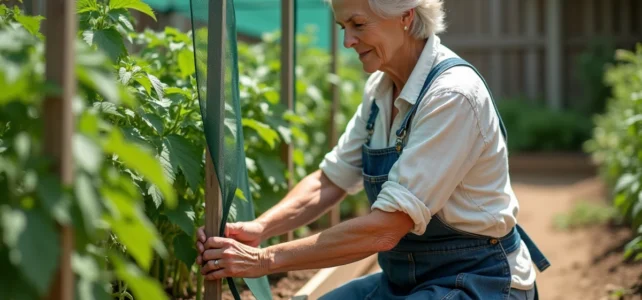
A shade net placed over tomatoes does not produce the same effect depending on whether it blocks 20%, 30%, or 50% of solar radiation. The shading rate determines both the temperature under the net, the ripening speed of the fruits, and the frequency of watering needed. Comparing these parameters allows you to choose a net suitable for the actual climate of your vegetable garden, not a theoretical average.
Shading rate for tomatoes: measured differences between 20% and 50%
Most gardening guides recommend nets with a shading rate between 30% and 50% for vegetables in general. When applied to tomatoes, this broad range often leads to a choice that is too opaque, hindering fruiting.
| Shading Rate | Light Transmitted | Effect on Tomatoes | Recommended Context |
|---|---|---|---|
| 20-30% | About 70-80% | Ripening preserved, photosynthesis slightly reduced | Outdoor garden, temperate to warm climate |
| 40-45% | About 55-60% | Temperature under the net capped at 36°C during heatwaves, production maintained | Greenhouse or tunnel, areas of prolonged high heat |
| 50% and more | Less than 50% | Notable slowdown in ripening, smaller fruits | Salads, spinach, shade plants (not tomatoes) |
Terre & Humanisme recommends a shade net for tomatoes in the vegetable garden with 20 to 30% shading, no more, to preserve ripening capacity. This threshold is significantly lower than the multi-vegetable recommendations circulating on most gardening sheets.
Organic farmers working under bi-tunnel greenhouses with a 45% net report that the temperature under the net does not exceed 36°C despite much higher outside peaks. Tomato production in open ground is maintained under these conditions. In contrast, this density is suitable for a confined environment (tunnel, greenhouse) where heat accumulates more than outdoors.
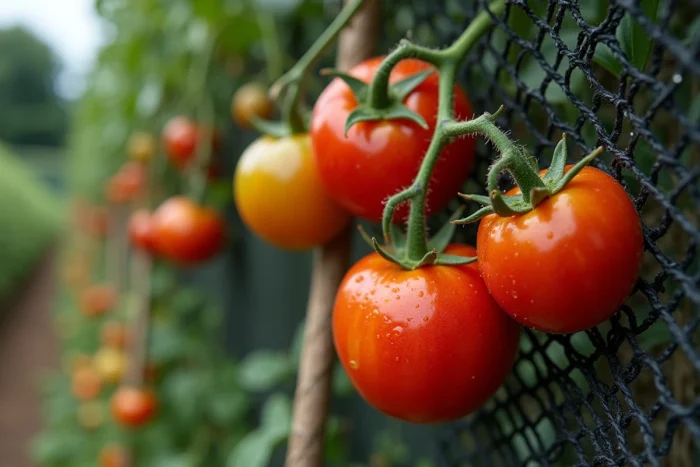
Shading, watering, and evaporation: the link that product sheets ignore
A shade net not only protects the foliage from burns. It modifies the entire water balance around tomato plants.
By reducing direct radiation, the net decreases soil evaporation. The residual moisture after watering lasts longer, which spaces out water applications. In a vegetable garden exposed to full south, this reduction in evaporation can significantly change the summer watering frequency.
The relationship between shading and water management works both ways. A net that is too opaque certainly retains moisture, but also reduces the heat necessary for fruit ripening. Tomatoes need heat to concentrate their sugars. Constantly moist soil under a 50% net promotes fungal diseases (downy mildew, botrytis) without accelerating harvest.
- With a 20-30% net, watering remains regular but evaporation decreases enough to space out applications by one to two days during hot periods.
- With a 40-45% net, moisture stagnates longer: monitor the base of the plants to avoid excess water at the collar.
- Without a net, the soil dries on the surface within a few hours during high heat, necessitating thick mulching or bi-daily watering.
The choice of shading rate is therefore also determined by your watering system. A programmed drip system tolerates a denser net than manual watering with a hose.
Color of the shade net: black, white, or green for tomatoes
The color of the net influences the temperature under the fabric as much as the shading rate. At equal percentages, a black net absorbs more heat than a white net that reflects some of the radiation.
Black net
The most common in garden centers. It effectively blocks UV rays but accumulates heat through absorption. Under a 30% black net, the temperature at the foliage level remains higher than that obtained under a white net at the same rate. For a garden already exposed to marked heat, this difference matters.
White or pearl net
It diffuses light instead of absorbing it, providing more uniform lighting under the fabric. Tomatoes receive less direct radiation but maintain high ambient brightness. This is the most coherent compromise for outdoor tomatoes in Mediterranean regions or southern France.
Green net
Often chosen for aesthetic reasons, it falls between black and white in terms of thermal reflection. Its main advantage is visual integration into a garden, not a measurable performance gain for crops.
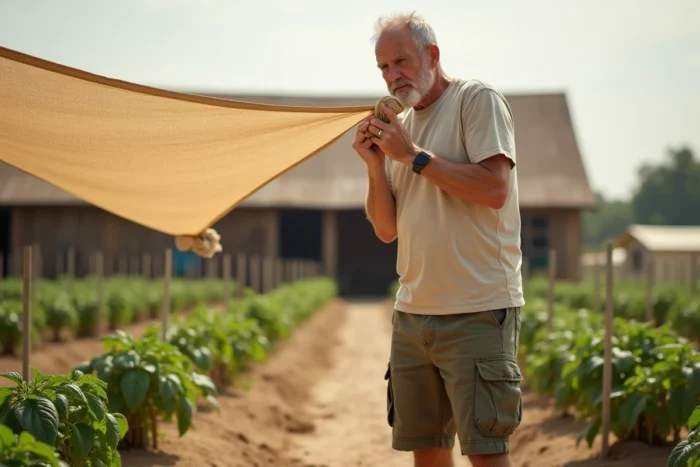
Installing a shade net on staked tomatoes
The height of installation directly affects air circulation under the net. A net pressed against the stakes creates a pocket of humid heat conducive to downy mildew. Leaving at least 30 to 50 cm between the tops of the plants and the net ensures sufficient ventilation.
For tomatoes staked on standard height stakes, the net is fixed to an independent structure: metal posts, hoops, or a wooden frame. Two configurations work well:
- Low tunnel hoops (like forcing cloth) cut to the right width, net tensioned with clips or string. Quick assembly, removable in autumn.
- Fixed frame with wooden battens with the net stapled on top. More stable in strong winds, suitable for long rows.
- Corner stakes with cable tensioned between them, net placed over and weighted at the edges. An economical solution for large areas.
The net should be easy to remove or raise. At the beginning and end of the season, when temperatures drop, tomatoes need all available radiation to complete ripening. A removable fastening system avoids having to cut or detach the net with each change in weather.
In terms of orientation, prioritize coverage on the south and west sides, where the sun hits hardest between 12 PM and 5 PM. Covering the entire row is not always necessary if the vegetable garden benefits from natural partial shading (hedge, wall, tree) on one side.
The shade net for tomatoes comes down to a trade-off between transmitted light and blocked heat. A rate of 20 to 30% covers most outdoor situations. Increasing to 40-45% is justified only under greenhouse conditions or in prolonged heatwave climates.
The white color offers the best balance between thermal protection and maintenance of brightness. Everything else depends on the height of installation and the ability to remove the net when the sun becomes an ally again.