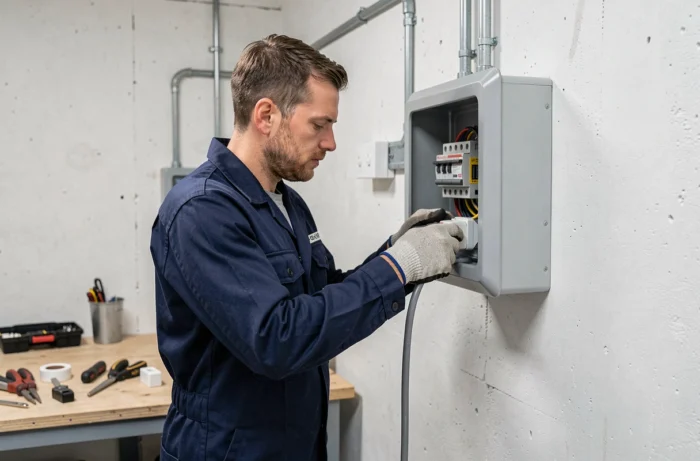
On a new house construction site, the electrical installation represents a significant portion of the finishing budget. When comparing traditional wiring done wire by wire to a pre-assembled electrical spider, the cost difference is not solely about materials: it’s the labor time that tips the scales. Understanding how the price of an electrical spider is constructed means first understanding what you are paying for and what you are actually saving.
Time savings on site: the real lever that reduces the cost of an electrical spider
It is often said that the electrical spider is cheaper than a traditional installation, without detailing the mechanism. The principle is simple: the spider arrives on site already assembled in the workshop, with its pre-wired ICTA conduits, connected junction boxes, and room-specific markings. The electrician just has to unroll and secure it.
Recent field feedback indicates a time savings of 30 to 40% on the wiring phase compared to traditional installation, both in new construction and in major renovations. This saved time directly translates into fewer billed labor hours.
Some specialized manufacturers report a overall cost difference of about 30% in favor of the spider compared to wiring done entirely on site. This figure includes the reduction of wiring errors, which avoids costly rework, and the decrease in intervention time. These data can be found in a comprehensive guide on Maison Info that details the components of the price based on configurations.
In practice, this gain varies depending on the complexity of the plan. A compact single-story house with few specialized circuits increases the advantage. A project with multiple bathrooms, a dual-flow ventilation system, and home automation circuits reduces the gap, as the upfront study time increases.
Factors affecting the price of an electrical spider kit per square meter
The cost of an electrical spider is not a standard package. Each kit is custom-made based on the electrical plan of the dwelling. Two houses of the same size can generate very different quotes.
Number of electrical points and specialized circuits
This is the first factor. Each outlet, switch, light point, or cable outlet adds wire, conduit, and assembly time. Specialized circuits (cooking hob, oven, washing machine, dryer, water heater) require larger cable sections and dedicated protections in the panel.
The more electrical points there are, the higher the unit cost per square meter. A dwelling equipped with the strict minimum required by the NF C 15-100 standard will cost significantly less than a dwelling with abundant outlets in every room.
Scope of service: supply only or supply and installation
An electrical spider kit can be sold as supply only, intended for a self-builder or an independent electrician. The price then only covers the prefabricated materials. If installation is included, the rate incorporates labor, connection to the electrical panel, and commissioning.
Elements that may be included or excluded from the quote:
- The equipped electrical panel (circuit breakers, residual current devices, terminals) represents a separate item that is not always included in the price of the spider
- The GTL (Technical Housing Conduit), which connects the panel to the communication box and the connection circuit breaker, is sometimes subject to a separate estimate
- Finishing equipment (plates, mechanisms for outlets and switches) is rarely included in the spider kit itself
Checking the exact scope of the quote avoids unpleasant surprises upon project completion.
New build or renovation: a real cost difference
In new construction, conduits are installed before the slab or in open partitions. Access is free, and unrolling is quick. In renovation, one must work with the existing conditions: chases in the walls, conduit passages in cluttered attics, adaptation to already installed boxes. The additional cost in renovation compared to new construction is significant, mainly due to the time needed for on-site adjustments.

Electrical spider quote: traps to spot before signing
Requesting multiple quotes is a basic precaution, but it is still necessary to compare equivalent services. Here are the points that generate the most misunderstandings between the client and the provider.
The electrical diagram is the key piece. Without a validated plan, no electrical spider quote is reliable. A serious manufacturer requires a scaled plan or conducts the study themselves before estimating. If you are offered a price over the phone without having seen the plan, it is a warning signal.
Compliance with NF C 15-100 must be explicitly mentioned. This standard sets the minimum number of outlets per room, mandatory circuits, and safety volumes in bathrooms. A kit that does not comply with this standard will expose the project to rejection by the Consuel during commissioning.
- Ask if the Consuel inspection is included in the service or if it is the responsibility of the project owner
- Check that the quote specifies the cable sections used for each type of circuit
- Ensure that the exact number of points per room matches the provided plan, not a generic standard
Electrical spider and NF C 15-100 standard: what the budget must cover
The NF C 15-100 standard imposes minimums per room: number of outlets, dedicated circuits for kitchens and bathrooms, appropriate differential protection. These requirements are not optional; they condition the obtaining of the Consuel certificate necessary for connection to the network.
An electrical spider kit designed by an engineering office integrates these constraints from the planning phase. This is an advantage over traditional wiring, where each circuit is thought out as the project progresses, with a higher risk of forgetting.
Feedback varies on this point, but workshop prefabrication significantly reduces non-conformities detected during inspection. Therefore, the cost of the kit theoretically includes the peace of mind of compliance, provided that the provider works from a complete and up-to-date electrical plan.
The budget for an electrical spider is not limited to the price of the kit delivered on site. It is the combination of the study plan, prefabricated materials, installation, and normative compliance that determines the real cost. Comparing only prices per square meter without checking what each quote includes is comparing services that have nothing in common.