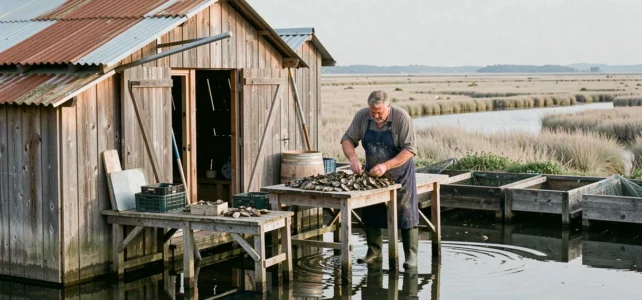
The oyster farm from “Tomorrow Is Ours” does not exist on the shores of the Thau lagoon. This setting, which has become one of the most recognizable in the TF1 soap opera, relies on a combination of studio shots and digital enhancements that even trick the locals of Sète. Understanding this fabrication sheds light on how the production manages all its filming locations.
Studio Set and Digital Touch-ups: The Creation of the Oyster Farm in DNA
The oyster farm as it appears on screen is a set built in the series’ studios. The interior scenes (the family table, the tasting counter, the back kitchen) are entirely filmed on these soundstages, near Sète.
For the exterior shots, the logic is similar to that applied to other recent sets. The most documented example in 2026 concerns the Kalésia hotel, filmed at the Laurens castle in Agde, an art nouveau site open to the public, whose exteriors were digitally altered in post-production to create a fictional island. The oyster farm follows the same logic of real sets complemented by visual effects, with views of the Thau lagoon integrated in the background to anchor the geographical illusion.
This hybrid approach (set + touch-up) allows the production to shoot quickly, without being dependent on the weather constraints or access issues typical of real oyster farms in the Thau basin. A detailed article discusses the exact location associated with the oyster farm in Sète in the series and its various hypotheses.
Outdoor Filming in Sète: What Is Real and What Is Not
The confusion between fiction and reality stems from a deliberate production choice. DNA uses real locations in Sète for some sets while creating others from scratch. The result blurs the references for viewers who then walk through the city.
Identifiable Locations in Sète
- The Spoon beach hut is a recurring set in the series. Only the exterior views are filmed on-site, while the interior bar is a studio set.
- Chloé Delcourt’s house is a permanent outdoor filming location, visible in the residential area of the city. The facades are authentic, while the interiors are recreated on set.
- The shared apartment (Victoire and Georges) is filmed in the Quartier Haut, utilizing its characteristic alleys and stairs.
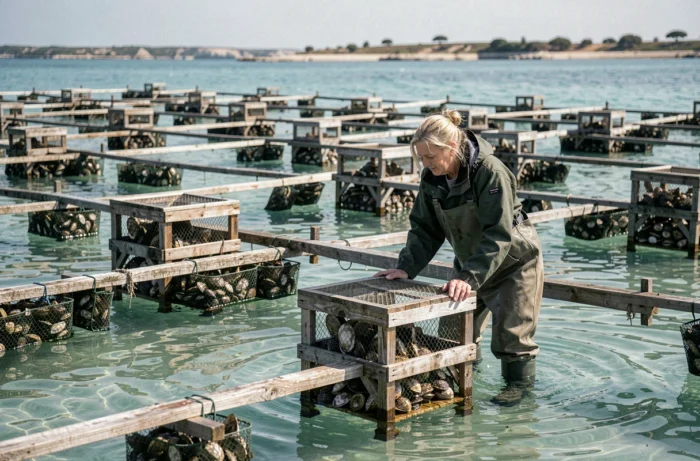
The oyster farm, however, does not correspond to any visitable shellfish farm. Fans who go to Sète hoping to find it on the shores of the Thau lagoon will only encounter real oyster parks, with no connection to the series’ set.
Why This Ambiguity Works
The production of DNA exploits the topography of Sète (canal, lagoon, sea) to create visual continuity. The transitions between outdoor shots and studio scenes are linked by cutaway shots of the water, boats, and real farms filmed with a telephoto lens. The viewer perceives a unique place where the production chain mixes several sources of images.
Cinétour Visits in Sète: The Farm as a Tourist Product
The Thau Archipelago tourist office has structured an offer around the series. Since the summer of 2026, Cinétour visits have taken thousands of visitors to the filming locations of “Tomorrow Is Ours,” by boat and on foot, with several departures each week. These tours pass by the accessible outdoor sets (Spoon, Chloé’s house, Quartier Haut) and along the Thau lagoon.
The lagoon landscape associated with the oyster farm is part of the tour, even though the interior set remains inaccessible as it only exists in the studio. The guides contextualize the difference between what the cameras show and what visitors can observe on-site.
This tourist offer transforms a daily soap opera into a local economic lever. The visits generate traffic to the port’s restaurants, authentic oyster farms, and downtown shops. The fictional farm, paradoxically, benefits the real oyster farmers of the Thau basin.
Real Sets Enhanced in Post-Production: The 2023-2026 Trend in DNA
The production strategy goes beyond just the oyster farm. For several seasons, DNA has intensified its use of real heritage sites, digitally altered to fit the fiction. The Laurens castle in Agde, transformed into the Kalésia hotel for the summer arc of 2026, illustrates this upgrade.
This art nouveau building, open to the public since June 2023, was filmed as is for its interiors. Its exteriors, however, underwent digital treatment to simulate an island location. The production combines accessible heritage and visual effects to create credible sets at a lower cost.
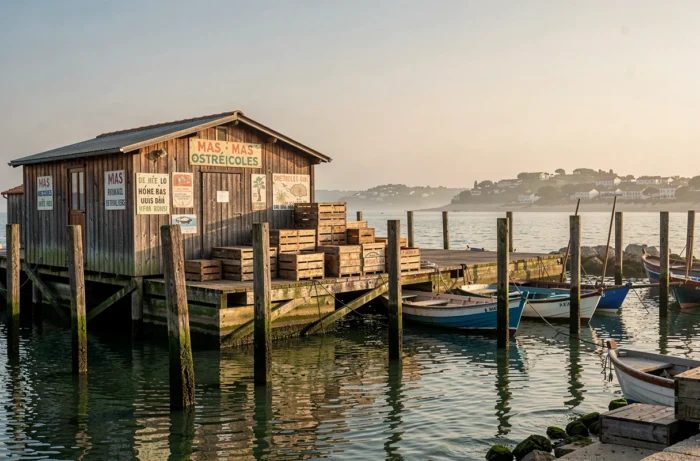
This method presents a narrative advantage. By relying on existing locations (a castle, a lagoon, a neighborhood), DNA anchors its plots in a setting that viewers can partially visit. The oyster farm fits into this logic: the Thau basin is real, the shellfish farming activity is too, but the farm as a filmed building remains a scripted construction.
The upcoming seasons are expected to extend this trend, with summer arcs filmed in heritage locations in Occitanie that are digitally enhanced in post-production. The soap opera functions as a regional tourist showcase, provided that one distinguishes between what is set and what is visitable heritage.
For fans planning a visit to Sète, the best approach remains to book a Cinétour for the outdoor sets, then extend with a visit to an oyster farm on the Thau lagoon. The series’ farm will not be there, but the oysters, indeed, are very real.